7 Tips for Choosing Direct Thermal Roll Labels?

Choosing the right Direct Thermal Roll Labels can seem simple until a printer jams during a busy shipping shift. Label width, core size, adhesive strength, and surface quality all affect daily performance. A roll that looks suitable online may still print poorly on your specific machine.

In practical labeling work, compatibility is often the overlooked detail. Check the printer model, maximum roll diameter, winding direction, and core measurement before ordering. A small mismatch can create uneven feeding or wasted labels. Test a sample roll before buying cartons. It is less exciting, but it prevents expensive mistakes.

Think about the label’s environment. Direct thermal materials work well for receipts, shipping labels, warehouse tags, and short-term identification. However, heat, sunlight, moisture, and friction can gradually darken or fade the image. A label stored beside a warm loading door may age faster than one kept in a cool cabinet. Choose the adhesive carefully. Smooth cardboard, plastic containers, refrigerated packaging, and dusty surfaces do not behave the same way.

The following seven tips focus on practical selection rather than attractive specifications alone. They cover material quality, printer settings, roll construction, adhesive performance, storage conditions, and testing methods. Some recommendations may not fit every operation. That is worth admitting. Your label supplier’s advice matters, but your own printer and working conditions matter more. A reliable choice should survive real handling, not just pass a product description.
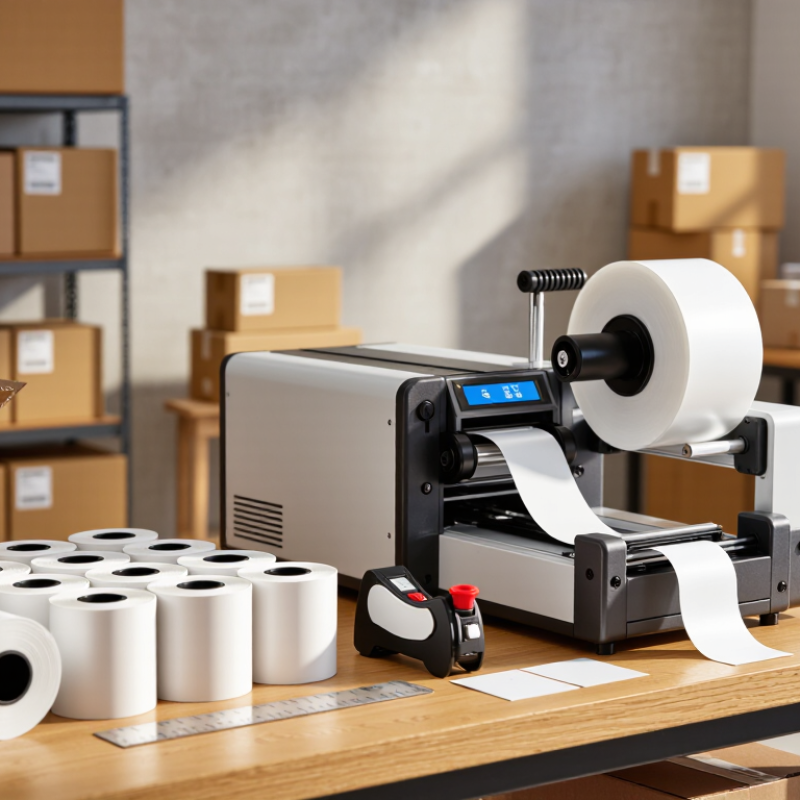
7 Tips for Choosing Direct Thermal Roll Labels?

Define the Application: Use 6–12-Month Shelf-Life Data for Paper Stock

A direct thermal roll label should match the product’s real life, not its planned life. Paper stock is usually practical for applications lasting 6–12 months, when exposure remains controlled. Industry guidance from TLMI and FINAT stresses that heat, light, moisture, and abrasion can shorten image durability. Storage near a sunny window can accelerate fading. A warehouse shelf is not a laboratory.

Define the application precisely. Record the label’s exposure time, surface type, temperature range, and handling frequency. The 2024 Label Industry Global Trends report identifies logistics and retail as major label users, but their conditions differ sharply. A shipping carton may need readable data for weeks. A pantry container may need legibility for a year. Test both. Print a small batch, then inspect samples after 30, 90, and 180 days. Use the actual printer, ribbonless setting, adhesive, and packaging.

Check barcode quality against ISO/IEC 15416 after storage and handling. A clear image is not enough if scanning fails. The ANSI grading scale can reveal gradual contrast loss. Do not trust a perfect first-day result. That assumption is easy to make, and often wrong. If labels face sunlight, condensation, chemicals, or repeated rubbing, paper stock may be a weak choice. A longer-life synthetic material could reduce replacement work, although its cost may be higher. The better decision comes from measured shelf-life data, not habit.

Match the Printer: Check 1- or 3-Inch Cores, Roll OD, Width, and 203/300 dpi

Choosing direct thermal roll labels starts with the printer, not the label box. Check the core first: 1-inch and 3-inch cores are not interchangeable. A loose core can wobble, while a tight core may not fit. Measure the roll’s outside diameter too. Many desktop printers accept compact rolls, while industrial units handle larger diameters. I measure the spindle and roll before ordering. It takes two minutes.

Width matters just as much. The label must sit inside the print path without touching guides. Leave enough space for sensors and edge detection. A 203 dpi printer creates dots about 0.125 mm wide; 300 dpi produces dots near 0.085 mm. That difference affects small text, dense barcodes, and fine symbols. GS1 General Specifications list a nominal 0.330 mm X-dimension for many retail barcodes, while ISO/IEC 15416 evaluates print quality through measurable grades. Higher dpi is not automatically better. Poor calibration still creates weak edges.

Industry research from Smithers forecasts thermal-printing demand to grow at roughly 5% annually through 2028, increasing the need for consistent media matching. Yet forecasts cannot replace a physical test. Print a full roll sample at normal speed. Check darkness, alignment, sensor gaps, and the final few labels. I once trusted the listed width and missed the core diameter. That mistake was avoidable. Record the printer’s core size, maximum roll OD, usable width, and dpi before purchase.

Select the Face Material: Compare 70–90 gsm Paper with Synthetic Films

Choosing the face material decides how a direct thermal label behaves in real use. A 70–90 gsm paper face is light, economical, and easy to convert. It suits receipts, warehouse bins, and short-term shipping labels. The 80 gsm range also gives a balanced feel on compact roll printers. Smithers’ direct thermal paper market analysis identifies retail, logistics, and transport as major demand sectors, where fast, readable printing remains essential.

Tip: Match the gsm to handling time. Use 70 gsm for brief indoor use. Choose 90 gsm when labels face repeated handling. Paper can wrinkle near condensation or rough carton edges. I have seen a lower-cost roll fail because the label surface absorbed moisture overnight. That small saving created reprinting work.

Synthetic films, such as polypropylene or polyester, resist water, abrasion, oils, and tearing better than paper. They are suitable for chilled storage, outdoor containers, and returnable totes. A 2023 AWAreness Report on pressure-sensitive labeling highlights continued demand for durable labels in logistics and industrial applications. Film usually costs more, but replacement labor can outweigh the material difference. Check printer compatibility carefully. Some films require different heat settings, and excessive energy can darken images. Also review the adhesive, not only the face stock. A strong film with weak adhesion still fails. This is where many specifications feel complete, but are not.

Direct Thermal Roll Label Face Materials: Paper vs. Synthetic Films

Comparative selection scores from 1 (low) to 5 (high), based on typical material characteristics. Actual performance depends on coating, adhesive, printer settings, storage conditions, and end use.

Paper face stocks in the 70–90 gsm range generally provide strong printability, lower cost, and better compatibility with paper recycling streams. Synthetic films such as polypropylene and polyester typically provide substantially better moisture and tear resistance, making them more suitable for refrigerated, outdoor, chemical, or high-abrasion applications. Choose the lightest face material that meets the label’s durability requirements.

Test Durability: Verify ISO/IEC 15416 Barcode Grade C (1.5) or Higher

Choosing direct thermal roll labels requires more than checking print darkness. Test barcode durability under real handling conditions. A warehouse label may face friction, moisture, sunlight, temperature changes, and repeated scanning. Verify the printed barcode with a calibrated verifier, not only a handheld scanner. The target should be ISO/IEC 15416 Grade C, or 1.5, at minimum.

Tip: Test fresh labels and aged samples. Store some rolls for several days before verification. Scan them after rubbing the surface with a dry cloth, placing them under typical warehouse lighting, and exposing them to expected temperature changes. Record edge contrast, modulation, defects, and decodability. A single successful scan proves very little. It can hide weak bars that fail later.

Tip: Test at the planned print speed and darkness setting. Excessive heat may create dark, blurry edges, while insufficient heat can produce broken bars. Check several labels across the roll, including the beginning, middle, and end. I once found acceptable results in the first section, but weaker contrast near the roll’s core. That result was inconvenient, yet useful. It showed why sampling only one label can create false confidence. Keep verification records with the material batch, printer settings, test date, and measured grade. Reliability comes from repeatable evidence, not appearance.

Check Compliance and Storage: Specify BPA-Free, FSC, and 20–25°C / 45–55% RH

7 Tips for Choosing Direct Thermal Roll Labels

Tip 1: Check chemical compliance before comparing prices. Under EU REACH, thermal paper containing 0.02% or more BPA has been restricted since January 2020. Request a current declaration of conformity, not a vague “eco-friendly” claim. BPA-free materials can still contain other developers, so ask for technical data and migration information.

Tip 2: Specify FSC-certified paper when responsible sourcing matters. FSC’s 2023 Facts & Figures reported more than 160 million hectares of certified forest worldwide. However, FSC certification applies to the material’s supply chain, not automatically to every finished label. Confirm the certificate scope and chain-of-custody details. I have seen purchasing teams miss this small distinction.

Tip 3: Control the storage room. Keep unused rolls at 20–25°C and 45–55% relative humidity. Store them in sealed cartons, away from sunlight, heaters, solvents, and strong plastic odors. Direct thermal coating reacts to heat, moisture, pressure, and chemicals. A warm loading dock can quietly damage a perfect roll.

Tip 4: Test labels after storage, not only on delivery. Print dense black areas, small text, and barcodes. Then check contrast, curl, adhesive performance, and fading. The International Organization for Standardization’s ISO/IEC 15415 supports objective barcode quality testing. Some suppliers provide impressive samples, but real warehouse conditions are less forgiving. Keep a retained sample for comparison.

7 Tips for Choosing Direct Thermal Roll Labels? - Check Compliance and Storage: Specify BPA-Free, FSC, and 20–25°C / 45–55% RH

No. Selection Dimension Recommended Specification Why It Matters Verification Checklist
1 BPA and developer chemistry Specify BPA-free direct thermal paper and request a current material declaration. If required by the application, also evaluate BPS and other bisphenol developers. Thermal coatings may contain color developers. BPA-free does not automatically mean free of every bisphenol or suitable for food-contact use. Obtain a signed declaration, safety data where applicable, and a coating composition statement. Confirm whether the requirement is BPA-free, bisphenol-free, or both.
2 FSC fiber sourcing Specify FSC-certified paper when responsible forest sourcing or an FSC claim is required. Identify the applicable FSC claim and product category. FSC certification addresses responsible forest-based material sourcing; it does not certify the thermal coating, adhesive, print quality, or end-use safety. Check the certificate status, scope, claim type, and transaction or product documentation. Do not use the FSC label without the required authorization.
3 Storage temperature and humidity Store unused rolls at 20–25°C and 45–55% relative humidity, unless the product specification states a different validated range. Heat, moisture, sunlight, and large temperature changes can accelerate background discoloration, reduce image stability, or affect adhesive performance. Use a calibrated thermometer and hygrometer. Keep rolls in their original packaging, away from direct sunlight, heaters, solvents, and high-moisture areas.
4 Image life and environmental exposure Define the required readable life and exposure conditions, such as indoor filing, refrigerated logistics, sunlight, abrasion, or contact with plasticizers and oils. Direct thermal images are generally more sensitive to heat, light, friction, and chemicals than many conventionally printed labels. Request accelerated-aging or application-test results. Test the actual barcode, text size, surface, storage period, and expected handling conditions.
5 Adhesive and label surface Match permanent, removable, or freezer-grade adhesive to the application surface and temperature range. Confirm face stock, liner, caliper, and roll construction. A suitable thermal coating cannot compensate for lifting, flagging, adhesive transfer, or poor adhesion caused by the wrong adhesive or surface. Test on the real substrate after application, dwell time, refrigeration or heat exposure, condensation, and rubbing. Confirm die-cut accuracy and edge quality.
6 Printer and barcode compatibility Match roll width, core diameter, outside diameter, winding direction, gap or black-mark format, and thermal sensitivity to the printer and label software. Incorrect dimensions or sensitivity can cause feeding errors, weak contrast, printhead buildup, unreadable barcodes, or premature printhead wear. Run production-equivalent samples. Verify barcode readability using the applicable quality standard and confirm reliable feeding at the intended print speed.
7 Traceability and quality control Require lot identification, production date, roll dimensions, material specification, inspection records, and a defined complaint or replacement process. Traceability makes it easier to isolate coating variation, adhesive defects, storage damage, or changes between production lots. Approve a pre-production sample, retain a reference roll, record incoming inspection results, and apply first-in-first-out stock rotation.
Important: BPA-free, FSC certification, and storage conditions are separate requirements. Confirm the applicable legal, environmental, food-contact, transport, and record-retention requirements for the intended market and application.