Why Choose High Quality Circuit Breaker Parts?
Choosing reliable Circuit Breaker Parts is not a minor purchasing decision. It directly affects protection, uptime, maintenance costs, and user safety. A breaker may look simple from the outside. Inside, every contact, spring, terminal, arc chute, and insulating component must perform under pressure.
In real maintenance work, small defects often create large problems. A loose terminal can generate heat. A worn contact may cause repeated tripping. An inaccurate replacement part can change the breaker’s timing or interrupting performance. These issues may remain hidden during a quick visual inspection. They often appear later, when equipment is heavily loaded or exposed to vibration.
High-quality parts are designed around precise dimensions, suitable materials, and verified electrical performance. They should match the breaker’s model, rating, application, and installation requirements. Product documentation matters. So does supplier experience. A trustworthy source can provide traceable specifications, inspection information, and practical technical support instead of vague promises.
But quality is not only about a higher price. That assumption deserves review. The cheapest component may create repeated labor, downtime, and replacement expenses. An expensive part may also be unsuitable if compatibility is ignored. Careful selection remains essential.
This guide examines why dependable Circuit Breaker Parts deserve attention. It considers safety, service life, consistency, compatibility, and long-term value. It also recognizes an uncomfortable reality: no component lasts forever. Regular inspection, correct installation, and qualified maintenance still matter. Better parts reduce risk, but they do not replace responsible engineering judgment.
What Are Circuit Breaker Parts and Why Do They Matter?
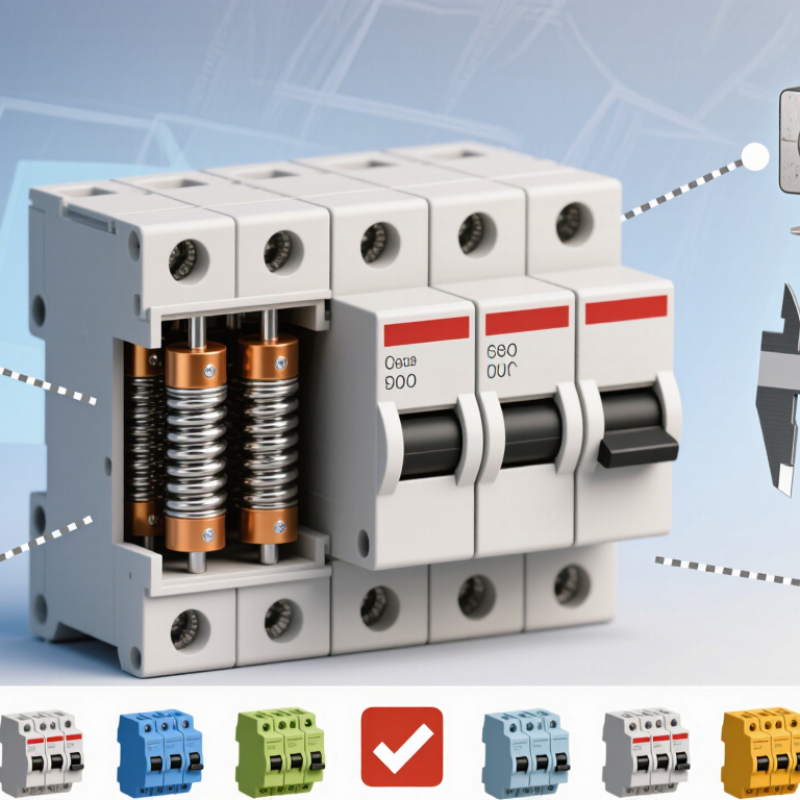
Circuit breaker parts are the working pieces inside a protective switching device. They include contacts, trip units, terminals, arc chutes, springs, and insulated housings. Each part performs a specific job during normal operation or a fault.
When current rises dangerously, the trip mechanism must respond quickly. The contacts separate, while the arc chute helps control the electrical arc. Weak contacts can create resistance, heat, and discoloration around terminals. A poorly matched trip unit may cause delayed protection or unnecessary interruptions. High quality parts usually provide better dimensional accuracy, stronger materials, and more consistent performance under repeated switching. Compatibility still matters. Even excellent parts may fail when installed incorrectly.
Tips: Check ratings, dimensions, connection points, and operating conditions before replacement. Inspect for pitting, loose screws, brittle insulation, and unusual heat marks. Follow verified technical instructions. Ask a qualified electrician when testing involves energized equipment.
Small details matter. During maintenance, technicians should record trip behavior and torque values. This evidence makes future diagnosis more reliable. Yet inspections are not perfect. Dust, vibration, aging, and hidden damage can escape a quick check. That is why documented testing and periodic review remain important. Reliable circuit breaker parts support safer operation, but they cannot correct poor installation or neglected maintenance. A careful choice is only part of the protection system.
How Does Part Quality Affect Circuit Breaker Performance?
Why Choose High Quality Circuit Breaker Parts?
How Does Part Quality Affect Circuit Breaker Performance?
Part quality directly affects how quickly and safely a circuit breaker responds to abnormal current. A poorly made contact may develop rough surfaces, increasing resistance and heat. That heat can damage insulation and shorten the breaker's service life. In field maintenance, technicians often find that small defects create larger problems after repeated switching.
Reliable parts are produced with controlled materials, accurate dimensions, and stable manufacturing processes. A correctly shaped trip component helps the mechanism react within its designed operating range. Strong terminals also maintain firm connections when equipment experiences vibration or temperature changes. These details matter in panels that operate continuously.
Testing should include mechanical movement, electrical continuity, insulation condition, and thermal performance. A clean-looking part can still hide weak springs or inconsistent plating. I have seen visual inspections give false confidence. That is why documented testing and traceable inspection records are valuable. Technicians should also compare replacement parts with the breaker’s specifications, not only its appearance.
Quality does not mean perfection. Mistakes can still occur during installation, storage, or maintenance. Dust, excessive tightening, and poor alignment may reduce performance. Regular inspection helps reveal these issues before contacts overheat or the mechanism fails to trip. Careful workmanship remains part of the part’s real quality.
Why Choose High Quality Circuit Breaker Parts?
How Does Part Quality Affect Circuit Breaker Performance?
This chart shows the calculated heat loss at a constant current of 100 A RMS using P = I²R. Lower contact resistance produces less heat, reduces thermal stress, and helps preserve stable circuit breaker performance. The resistance values represent an engineering example rather than a universal product rating.
Which Materials and Manufacturing Features Define High Quality?
High-quality circuit breaker parts begin with controlled materials, not attractive packaging. Copper or copper alloys should carry current with low resistance and stable conductivity. Silver-based contact materials can reduce welding during repeated interruption. The exact alloy matters. One detail is easy to miss. Plating thickness, adhesion, and surface cleanliness directly affect contact heating. Thermoset or high-temperature engineering plastics should resist tracking, cracking, and deformation near hot terminals. IEC 60947-2 type tests assess temperature rise, short-circuit performance, insulation, and endurance under defined conditions.
Manufacturing discipline separates reliable parts from merely similar parts. Precision stamping keeps contact geometry consistent, while calibrated torque prevents loose joints and damaged threads. Automated inspection can detect burrs, voids, and misaligned arc-chute components before assembly. IEA’s Electricity 2024 report forecasts global electricity demand will grow by 3.4% annually from 2024 through 2026. That growth increases the importance of dependable switching hardware across commercial and industrial systems. In practical inspections, I look for clean contact faces, uniform plating, firm rivets, and traceable batch records. A low-cost component may pass a visual check yet fail after thermal cycling. That is the uncomfortable part. Material certificates and independent test evidence still need careful review. Even experienced buyers can overtrust a familiar specification.
Why Choose High Quality Circuit Breaker Parts? - Which Materials and Manufacturing Features Define High Quality?
| Circuit Breaker Part | Preferred Material or Feature | Quality Characteristics | Why It Matters | Typical Verification Method |
|---|---|---|---|---|
| Main current-carrying terminals | High-conductivity copper or copper alloy with a corrosion-resistant surface finish | Low electrical resistance, adequate mechanical strength, stable contact interface, and controlled plating thickness | Reduces voltage drop, localized heating, oxidation, and loosening during service | Material certification, dimensional inspection, coating inspection, torque testing, and temperature-rise testing |
| Fixed and moving contacts | Silver-based contact material or a suitable silver alloy selected for the rated current and interrupting duty | Good electrical conductivity, resistance to welding, controlled contact pressure, and low arc erosion | Supports reliable current transfer and consistent opening and closing performance | Contact-resistance measurement, endurance cycling, visual inspection, and short-circuit performance testing |
| Arc runners and arc splitter plates | Magnetic steel components with accurate geometry and suitable heat-resistant insulation around the arc chamber | Correct plate spacing, secure positioning, burr-free edges, and resistance to repeated thermal stress | Helps divide, cool, and extinguish the arc while limiting damage to surrounding parts | Dimensional inspection, assembly checks, dielectric testing, and interrupting-capacity testing |
| Operating mechanism | Hardened or precision-formed steel components, wear-resistant pivots, and controlled spring characteristics | Consistent spring force, low friction, accurate over-center action, and secure latching | Provides dependable manual operation and fast, repeatable fault interruption | Operating-force measurement, timing tests, endurance cycling, and latch-release testing |
| Thermal trip element | Calibrated bimetal strip with stable thermal characteristics and controlled forming | Repeatable deflection, accurate calibration, and stable behavior over the specified ambient-temperature range | Enables dependable overload protection without nuisance operation outside the specified limits | Current-time characteristic testing at defined ambient temperatures and calibration checks |
| Magnetic trip element | Precision magnetic core, coil, armature, and calibrated air gap | Stable magnetic response, controlled trip threshold, and fast actuation during high-current faults | Supports rapid short-circuit protection and helps limit let-through energy | Magnetic trip-current testing, response-time measurement, and dimensional inspection |
| Insulating housing and barriers | Flame-retardant thermoplastic or thermoset molding compound with suitable electrical insulation properties | High insulation resistance, dimensional stability, flame resistance, and resistance to heat and impact | Maintains safe clearances and reduces the risk of tracking, fire propagation, and mechanical failure | Flammability evaluation, insulation-resistance testing, dielectric withstand testing, and impact testing |
| Trip actuator and handle | Dimensionally stable engineering polymer with reinforced interfaces and positive position indication | Smooth movement, clear ON/OFF/TRIP positions, resistance to impact, and secure attachment | Improves user safety and helps prevent incorrect operation or ambiguous status indication | Mechanical endurance, impact testing, dimensional checks, and visual-position verification |
| Terminal screws and fasteners | High-strength steel or corrosion-resistant alloy with controlled thread geometry and compatible washers | Consistent torque retention, adequate clamping force, resistance to stripping, and corrosion protection | Maintains a low-resistance connection under vibration, heating, and repeated servicing | Torque testing, thread-gauge inspection, pull-out testing, and corrosion evaluation |
| Manufacturing process control | Controlled stamping, molding, plating, assembly, calibration, and traceability procedures | Tight dimensional tolerances, repeatable assembly force, documented inspection points, and batch traceability | Reduces variation between units and improves long-term reliability and safety consistency | Statistical process control, first-article inspection, 100% functional checks, and sample type testing |
| Compliance and performance testing | Testing against the applicable circuit-breaker standard, such as IEC 60947-2, IEC 60898-1, or UL 489 | Verified ratings for current, voltage, temperature rise, dielectric strength, endurance, and short-circuit performance | Confirms that the complete breaker and its parts perform safely under defined operating conditions | Laboratory type tests, routine production tests, rating verification, and documented conformity records |
Note: Material selection and test requirements depend on the circuit breaker design, rated current, rated voltage, utilization category, environmental conditions, and applicable regional standard.
What Risks Can Low Quality Circuit Breaker Parts Create?
Low-quality circuit breaker parts can turn a routine protection device into a hidden ignition risk. Poor contacts may create excess resistance, heat, and unstable tripping. Weak springs can delay interruption during a fault. Damaged insulation may also support tracking or arcing inside the enclosure. Small defects matter.
NFPA’s Electrical Fires report estimated 35,150 U.S. home fires involving electrical distribution and lighting equipment each year from 2015 to 2019. These fires caused about 470 deaths, 1,100 injuries, and 1.3 billion dollars in property damage annually. The report does not isolate low-quality breaker parts, which is an important limitation. Still, the figures show how electrical failures can escalate quickly.
In field maintenance, technicians should verify material certificates, dimensional accuracy, contact quality, and thermal performance. Parts should match the breaker’s tested design and applicable requirements, such as IEC 60947-2 or UL 489. A cheaper spring or terminal may pass a visual inspection but fail under repeated load cycles. That is the uncomfortable part. Appearance proves very little.
Independent testing should include temperature-rise checks, dielectric testing, short-circuit performance, and endurance tests. Traceable production records also help identify weak batches. Skipping these checks may save minutes, but it can create nuisance trips, equipment downtime, or delayed fault clearing. Reliability is built into details that users rarely see.
How Should You Select Reliable Circuit Breaker Replacement Parts?
Selecting reliable circuit breaker replacement parts requires more than matching voltage and frame size. In field maintenance, I check the original breaker’s interrupting rating, pole configuration, trip curve, terminal design, and enclosure temperature. A visually identical part may still fail under fault conditions. The replacement should meet the equipment manufacturer’s specifications and applicable standards, such as IEC 60947-2 or UL 489.
Verify the documentation.
Ask for traceable test records, production dates, and installation instructions. Confirm that the part was tested for short-circuit interruption, insulation performance, and mechanical endurance. NFPA’s 2023 Fire Loss in the United States report recorded about 1.5 million fires and 3,670 civilian fire deaths. Electrical protection cannot prevent every incident, but correct overcurrent protection reduces avoidable exposure. NFPA 70B also emphasizes documented electrical maintenance and condition-based inspection.
I also inspect the supplier’s quality process. Look for serial-number control, sample testing, warranty terms, and technical support from qualified engineers. Used or refurbished parts need extra scrutiny. Their history may be unclear. That is uncomfortable, but ignoring it is worse. Installation should include torque verification, insulation checks, and functional trip testing by competent personnel. One detail is often missed: the replacement breaker must coordinate with upstream and downstream protective devices. A part can pass a bench test yet cause nuisance trips in a real panel. Independent verification is worth the time. Reliability is not proven by appearance alone.

