

2026 Top Types of Bulk Snack Bags for Global Buyers
The 2026 snack market will demand packaging that protects food, controls cost, and fits changing retail channels. Bulk Snack Bags are central to this shift, especially for wholesalers, private-label brands, foodservice suppliers, and international distributors. Buyers must compare more than price. Film structure, seal strength, barrier performance, filling speed, and carton efficiency all influence total value.
Smithers’ The Future of Global Flexible Packaging to 2028 identifies steady growth in flexible packaging, supported by convenience, lightweight materials, and improved production efficiency. These drivers explain the growing interest in stand-up pouches, flat bags, gusseted bags, zipper bags, and high-barrier laminated formats. PMMI industry research also highlights automation, packaging flexibility, and sustainability as major investment priorities. A bag that runs smoothly on a high-speed line may still fail during long-distance shipping. Small details matter.
Consumer expectations add pressure. McKinsey’s 2023 Global Sustainability in Packaging report found that 60–70% of surveyed consumers may accept higher prices for more sustainable packaging. However, that finding does not guarantee demand in every market. Price sensitivity remains strong. Recycling infrastructure also differs widely between countries. That assumption needs testing.
This guide examines the top types of Bulk Snack Bags for global buyers in 2026. It considers product freshness, moisture and oxygen barriers, resealability, customization, transport durability, and end-of-life claims. The best choice is rarely the most attractive bag on a sample table. It is the format that performs reliably from factory filling to the customer’s pantry. Real-world trials still matter.
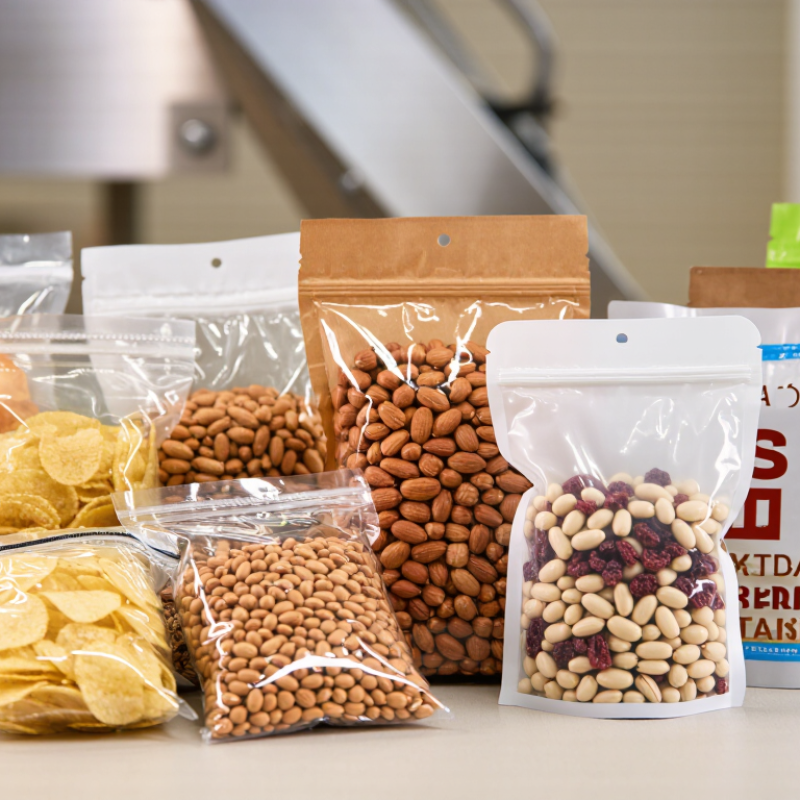
Bulk Snack Bag Types and Their Core Functions
2026 Top Types of Bulk Snack Bags for Global Buyers
Bulk Snack Bag Types and Their Core Functions
Stand-up pouches suit nuts, dried fruit, and mixed snacks. Their flat base keeps products upright on shelves. A zipper supports repeated opening, while a tear notch improves access. They also use less storage space than rigid containers. However, weak seals can fail under heavy filling conditions.
Flat-bottom bags provide strong stability for larger snack volumes. Their wide panels offer useful printing space and better shelf visibility. Gusseted bags expand sideways, making them practical for bulky chips or popcorn. Pillow bags support high-speed packing and usually reduce material use. They work well for single-serve or family-size portions.
Barrier performance matters more than appearance. Metallized or foil structures help limit oxygen and light exposure. Clear films improve product visibility but may offer less light protection. Paper-based laminates create a natural look, yet moisture resistance must be tested carefully. Resealable formats need zipper strength checks after repeated use. Do not rely on appearance alone. Buyers should confirm seal integrity, drop resistance, and food-contact documentation for each target market. Film thickness, pack size, filling temperature, and transport routes can change performance. A bag that works in a dry warehouse may struggle in humid conditions. My practical view is simple: select the structure after testing the product, not before.
| Bulk Snack Bag Type | Typical Construction | Primary Barrier Function | Common Closure or Format | Best-Suited Snack Applications | Key Advantages | Important Limitations | Typical Buyer Considerations |
|---|---|---|---|---|---|---|---|
| Stand-Up Pouch | Flexible multilayer film with a bottom gusset; may use laminated plastic or high-barrier structures. | Protects against moisture, oxygen, light, and aroma loss when the selected film structure is suitably rated. | Heat-sealed top, often with a zipper; can also include a tear notch or spout for suitable products. | Chips, nuts, trail mix, dried fruit, granola, seeds, and confectionery. | Good shelf presentation, efficient use of retail space, stable upright display, and convenient resealing. | Performance depends heavily on film selection and seal quality; multilayer formats can be difficult to recycle. | Check fill weight, pouch dimensions, zipper performance, seal strength, barrier data, and filling-line compatibility. |
| Flat Pouch | Two or more flexible film layers sealed around the edges without a bottom gusset. | Provides moisture and oxygen protection according to the laminate and seal design. | Three-side seal, four-side seal, tear notch, or a small resealable feature. | Single-serve snacks, seasonings, small nut portions, dried fruit, and promotional samples. | Lightweight, material-efficient, compact during transport, and suitable for automated form-fill-seal production. | Limited internal volume and poor upright stability; usually less suitable for large snack portions. | Confirm portion size, seal area, tear performance, film stiffness, and shipping protection requirements. |
| Pillow Bag | Flexible rollstock formed into a tube with a back or fin seal and two end seals. | Offers economical protection from humidity and contamination; barrier level varies by film structure. | Continuous form-fill-seal format, commonly with a fin seal and crimped ends. | Potato chips, popcorn, crackers, cookies, snack mixes, and other high-volume products. | Fast production, low material use, and efficient packing for high-volume snack lines. | Normally not resealable and can be more vulnerable to crushing unless the package includes adequate headspace and protection. | Evaluate rollstock width, seal temperature range, machine speed, gas-flushing capability, and product fragility. |
| Quad-Seal Bag | Gusseted flexible bag with four distinct vertical corner seals and a flat or shaped bottom. | Can provide strong moisture, oxygen, aroma, and light protection with appropriate laminated films. | Heat-sealed top, zipper option, or tin-tie style closure depending on the package structure. | Premium nuts, coffee-related snacks, granola, dried foods, and larger retail portions. | Excellent shelf presence, broad printable panels, strong structure, and good use of packing space. | More complex to manufacture than basic pillow bags; usually requires compatible bag-making and filling equipment. | Review corner-seal quality, bottom stability, filling speed, zipper alignment, and carton utilization. |
| Flat-Bottom Bag | Rigid-feeling flexible bag with a flat base, side gussets, and multiple sealed panels. | Supports high-barrier protection against moisture and oxygen when made with suitable laminated materials. | Top heat seal, zipper, or other resealable closure. | Large-format nuts, trail mix, granola, dried fruit, and premium snack assortments. | Strong upright display, efficient volume utilization, and a broad front panel for product information. | Higher material and tooling complexity than simple flexible formats; may increase packaging cost. | Consider target fill weight, base stability, shelf dimensions, production equipment, and pallet efficiency. |
| Paper-Laminated Snack Bag | Paper outer layer combined with a heat-sealable polymer or barrier layer; construction varies by product needs. | Paper supplies printability and a natural appearance, while the inner layer provides sealing and product protection. | Heat seal, folded closure, tin tie, zipper, or other format-specific closure. | Cookies, crackers, granola, bakery snacks, nuts, and dry products where a paper appearance is desired. | High-quality print surface, tactile feel, and potential for reduced plastic appearance compared with all-plastic bags. | Paper does not automatically make the entire package recyclable or compostable; moisture and grease resistance depend on the inner layer. | Request material-layer details, local recycling guidance, grease resistance, sealability, and verified sustainability claims. |
| High-Barrier Foil Bag | Flexible laminate containing an aluminum foil layer or a comparable high-barrier metallized structure. | Strong resistance to oxygen, water vapor, light, and aroma transmission. | Heat seal, zipper, or vacuum-compatible closure depending on the product and bag design. | Highly sensitive nuts, roasted snacks, dried fruit, nutritional snacks, and products requiring extended shelf stability. | Excellent protection for oxidation-sensitive and light-sensitive foods; supports long-distance distribution. | Aluminum foil laminates are generally difficult to recycle through standard flexible-plastic streams and may cost more than basic films. | Match barrier specifications to shelf-life targets, test seals after transport, and confirm applicable food-contact requirements. |
| Metallized Film Bag | Plastic film coated with a thin metallic layer, commonly used within a multilayer flexible structure. | Improves light, oxygen, moisture, and aroma protection compared with many clear film structures. | Usually heat-sealed in pillow, stand-up pouch, or flat-pouch formats. | Chips, cereal snacks, crackers, popcorn, confectionery, and dry snack mixes. | Often lighter and more flexible than foil laminates while offering useful barrier performance and visual opacity. | Barrier performance is lower than some foil structures and can be affected by flex cracking, pinholes, or poor seals. | Ask for oxygen transmission rate, water-vapor transmission rate, light protection, flex-crack testing, and seal specifications. |
| Compostable or Bio-Based Flexible Bag | Film structure using certified compostable polymers, bio-based polymers, or paper-based components, depending on the design. | Provides product protection only within the limits of the selected material; moisture and oxygen resistance may differ from conventional laminates. | Heat seal, tear notch, zipper, or gusseted pouch format where compatible with the material. | Dry snacks, natural-food products, short-to-medium shelf-life items, and products supported by suitable disposal systems. | Can support specific renewable-material or compostability objectives when properly certified and correctly disposed of. | Industrial composting may be required; local infrastructure is limited in some markets, and barrier or seal performance may require careful validation. | Verify recognized certification, disposal route, shelf-life testing, food-contact compliance, and country-specific labeling rules. |
| Resealable Zipper Bag | Flexible pouch or bag fitted with a press-to-close or slider zipper integrated into the top area. | Protects against moisture and contamination after opening when the zipper and top seal are correctly used. | Press-to-close zipper, slider zipper, tear-open initial seal, or a combination of these features. | Family-size nuts, trail mix, granola, dried fruit, crackers, and snacks consumed over multiple occasions. | Improves convenience, helps control repeated opening, and can reduce exposure to air and humidity between uses. | The zipper is not a substitute for a high-quality initial seal; fine particles can interfere with closure performance. | Test zipper force, alignment, reseal cycles, leak resistance, opening usability, and compatibility with the filling process. |
| Bulk Liner or Industrial Snack Sack | Large flexible liner or sack made from food-contact plastic film, woven material with a liner, or a multiwall paper structure. | Protects bulk contents from dust, moisture, handling contamination, and, when specified, oxygen exposure. | Heat seal, sewn closure, tie closure, or container-liner fit depending on the handling system. | Ingredient snacks, bulk nuts, seeds, cereal pieces, dried fruit, and foodservice or manufacturing supply. | High capacity, efficient palletization, simplified handling, and suitability for downstream repacking. | Requires careful handling to avoid punctures and contamination; generally not designed for direct consumer resealing. | Specify net weight, lifting and stacking conditions, liner thickness, food-contact documentation, pallet pattern, and storage humidity. |
| Vacuum-Compatible Bag | Multi-layer flexible film engineered to withstand air removal and maintain seal integrity. | Reduces oxygen exposure and helps limit oxidation and aerobic spoilage risks in suitable dry products. | Heat seal after vacuuming; some structures may also support gas flushing. | Dense nuts, dried fruit, specialty snacks, and products where reduced oxygen exposure is beneficial. | Can reduce package volume and help protect oxidation-sensitive products during storage and shipment. | Not suitable for every fragile snack because vacuum pressure may crush or deform the contents; equipment and process control are required. | Check puncture resistance, residual oxygen targets, product compression tolerance, seal strength, and vacuum-machine compatibility. |